

Programming #2 - Build a simple RAG application PART-1
I have made a simple naive retrieval-augmented generation (RAG) application created to respond to queries about based on facts about cats in a text file. Go to the Github repo for instructions on running the project or even contributing to it if you have cool ideas. You may embarrass me for mistakes 😁 This is level 1/100 in my deep learning journey. There’s a long way to go and I absolutely love the uphill climb.
PROJECT GOALS
The primary goals for this project were:
- Build without frameworks to learn the underlying mechanisms behind powering a RAG project. Abstractions will get in the way of my learning now. This will allow me to build a lot of divergent pathways in my brain around RAG.
- Make the project sufficiently modular so that the fundamental building blocks of the project can be tested in isolation and improved upon.
- Use as less cloud services as possible to learn how to build RAG apps on a local server.
BUILDING BLOCKS OF THE PROJECT
All RAG applications have broadly these fundamental building blocks - Data pipeline, Knowledge representation, Context/knowledge retrieval and Language generation. What you see below are my implementations of the blocks in this project.
- Data layer - storing data on cat facts in a
postgresdatabase on Supabase and usingpgvectoras a vector extension in postgres to store vector embeddings - Knowledge representation - Indexing fixed-size chunks with a local Ollama embedding model
mxbai-embed-large:latestand storing the embeddings in my postgres database table - Retrieval layer - basic cosine similarity search with top-n ranking
- Generation layer - generation with a local Ollama embedding model gemma3:4b with simple system and user prompts
PROVENANCE
The previous version of this project had the following implementations of the building blocks mentioned above:
- Data layer - local text file and an in-memory Python tuple to store vector embeddings
- Knowledge representation - Indexing fixed-size chunks with a local Ollama embedding model mxbai-embed-large:latest
- Retrieval layer - basic cosine similarity search with top-n ranking
- Generation layer - generation with a local Ollama embedding model gemma3:4b with simple system and user prompts
RAG TESTING FRAMEWORK
RAG EVALUATION
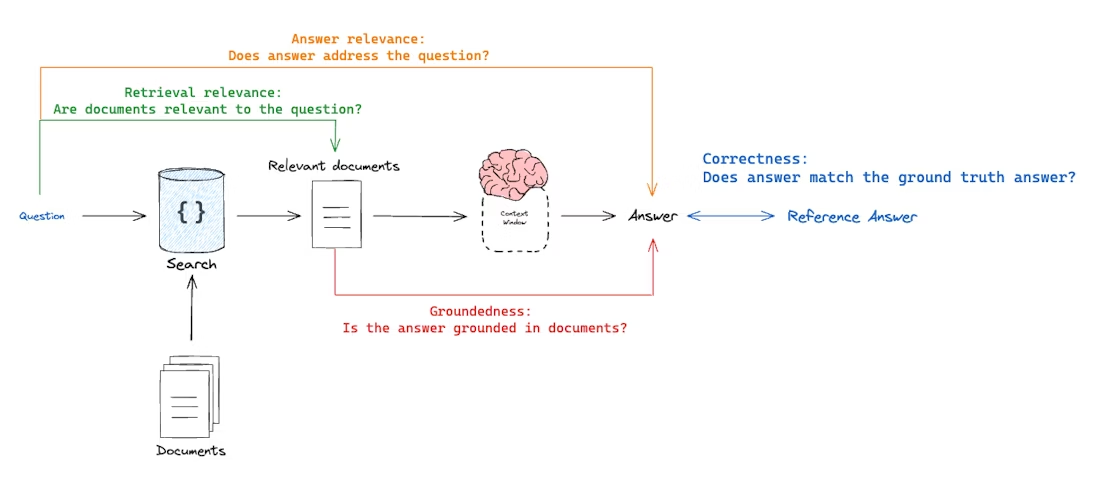
We can view RAG evaluation as a tuple of “what is being evaluated?” vs “what is it being evaluated against?“. There are different dimensions of this evaluation routine, written as separate evaluators. An LLM (Ollama ‘gemma3:4b’) was used as a judge for assessments. In this application, you can see for yourself how effective it was or not.
- Correctness - Response vs Reference answer (how accurate the response is, agnostic of context) Goal: Measure “how similar/correct is the RAG chain answer relative to a ground-truth answer”
- Relevance - Response vs Input Goal: Measure “how well does the RAG chain answer address the input question”
- Groundedness - Response vs retrieved docs Goal: Measure “to what extent does the generated response agree with the retrieved context”
- Retrieval Relevance - Retrieved docs vs input Goal: Measure “how relevant are my retrieved docs/results for this query
- Context recall - Retrieved docs vs Reference docs: Measure “how many of the correct docs are retrieved as context”
NEXT STEPS
- Add more examples to better test the full scope of the application.
- Improve context recall by testing different embedding strategies (maybe make embedding modular so that I can swap in and out different embedding methods and test them in isolation while controlling other variables)
- Latency measurement (now it takes way too long to generate locally on my machine, want to see if I can bring the time down)
- Throughput measurement (want to measure how many responses per unit time this application can handle)
- Build my own custom RAG tests dashboard
- This application produces inconsistent responses which also contain some hallucinations in the generation phase. I need to have better parameters for more determinism (ex - lower temperature, fixed seed values, etc). The prompt instruction plays the biggest role in deterministic answers. I need to come up with a super strong template.